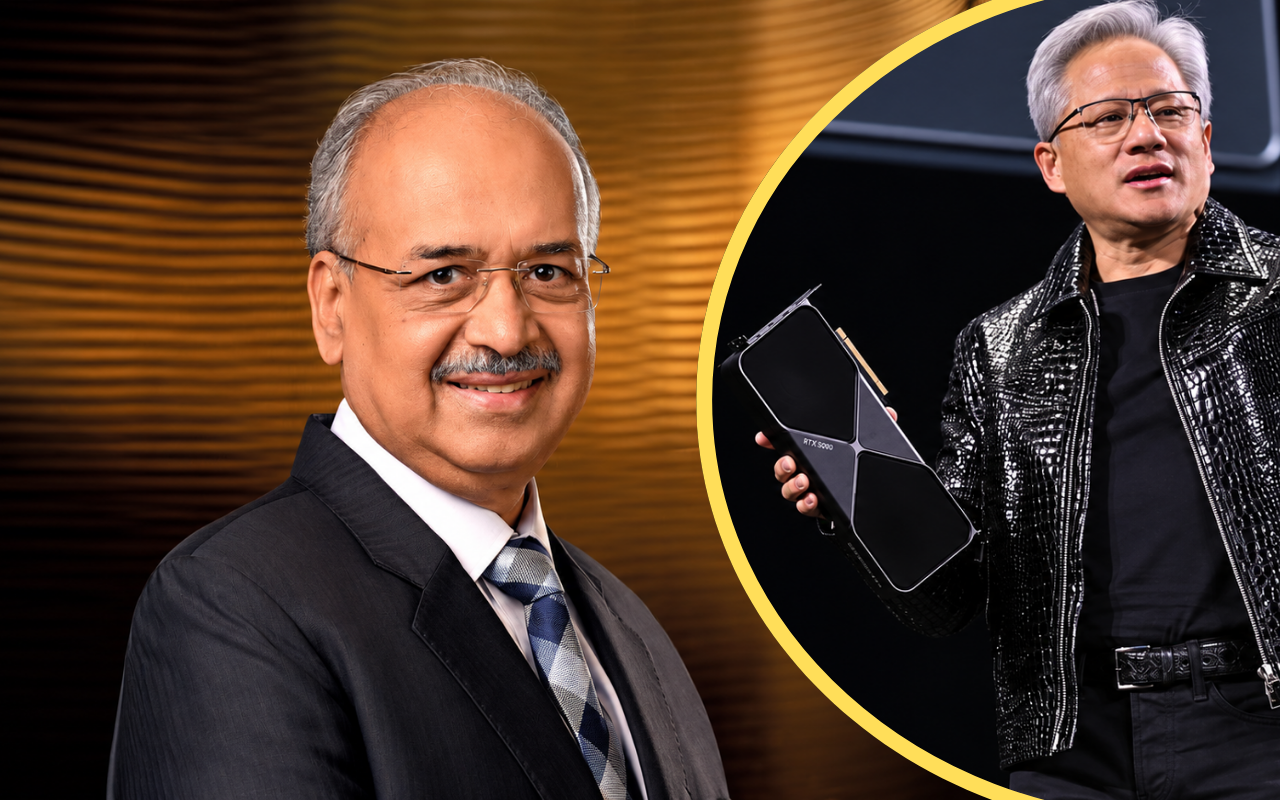
Dilip Shanghvi and Jensen Huang are two remarkable entrepreneurs who transformed small beginnings into globally recognized business success stories. Although they belong to completely different industries, their journeys show how vision, innovation, patience, and strong leadership can create companies that influence millions of people. Dilip Shanghvi built Sun Pharmaceutical Industries into one of the world’s leading pharmaceutical companies, while Jensen Huang co-founded NVIDIA and helped shape the modern artificial intelligence and computing revolution.
Their stories are often discussed together because both represent a new generation of global entrepreneurs who did not simply follow existing markets. Instead, they identified opportunities, solved major problems, and built companies that became leaders in their fields.
Early Life of Dilip Shanghvi
Dilip Shanghvi was born on October 1, 1955, in Amreli, Gujarat, India. He grew up in a business family where his father worked in the pharmaceutical distribution industry. His early exposure to medicines and business operations helped him understand the pharmaceutical market from a young age. He later completed his Bachelor of Commerce degree from the University of Calcutta.
Unlike many entrepreneurs who start with large investments and extensive resources, Shanghvi began his business journey with limited capital. He understood that the pharmaceutical industry had significant opportunities, especially in producing affordable medicines for patients.
His early experiences taught him the importance of understanding customers, managing costs, and creating products that solve real-world problems. These lessons became the foundation of his future success.
The Beginning of Sun Pharmaceutical Industries
In 1983, Dilip Shanghvi founded Sun Pharmaceutical Industries with a small investment borrowed from his father. The company initially focused on producing medicines for psychiatric conditions, an area where Shanghvi saw strong potential.
At the beginning, Sun Pharma was a small company operating with limited resources. However, Shanghvi focused on quality, specialized medicines, and steady growth rather than rapid expansion. His strategy was based on building a strong reputation among doctors and patients.
Over the years, Sun Pharma expanded its product portfolio and entered international markets. Through strategic acquisitions and business expansion, the company became one of the largest generic drug manufacturers globally. A major milestone came in 2014 when Sun Pharma acquired Ranbaxy Laboratories, strengthening its position in the global pharmaceutical industry.
Dilip Shanghvi’s Business Philosophy
One of the key reasons behind Dilip Shanghvi’s success is his long-term approach to business. Instead of focusing only on short-term profits, he emphasized sustainable growth, research, and market understanding.
Shanghvi became known for making careful decisions and studying opportunities before investing. His leadership style was different from many aggressive entrepreneurs because he preferred calculated moves and gradual expansion.
His journey from a small pharmaceutical entrepreneur to the leader of a global healthcare company became an example for many business owners. It showed that companies can grow through patience, strategic thinking, and consistent improvement.
Early Life and Background of Jensen Huang
Jensen Huang was born on February 17, 1963, in Taipei, Taiwan. During his childhood, he lived in Taiwan and Thailand before moving to the United States. He studied electrical engineering at Oregon State University and later earned a master’s degree from Stanford University.
Before becoming a famous technology leader, Huang worked in the semiconductor industry and gained valuable experience in computer chip design. His technical background helped him understand the future potential of graphics processing and advanced computing.
Huang’s journey was shaped by curiosity, engineering skills, and a willingness to take risks. These qualities later played an important role in building NVIDIA into one of the most influential technology companies in the world.
The Creation and Growth of NVIDIA
In 1993, Jensen Huang co-founded NVIDIA with Chris Malachowsky and Curtis Priem. The company initially focused on graphics processing units (GPUs) for computer graphics and gaming.
At that time, many people viewed GPUs mainly as tools for improving video game graphics. However, Huang recognized that GPU technology could have much broader applications because of its ability to process large amounts of data quickly.
NVIDIA invested heavily in developing GPU technology and software platforms that could support advanced computing. This vision later became extremely important as artificial intelligence, machine learning, and data processing grew worldwide.
Under Huang’s leadership, NVIDIA moved beyond gaming and became a major supplier of AI computing technology. Today, NVIDIA’s chips are widely used for artificial intelligence research, cloud computing, autonomous systems, and advanced scientific applications.
Jensen Huang’s Leadership Style
Jensen Huang is known for his focus on innovation, engineering excellence, and long-term technology trends. Since NVIDIA’s founding, he has remained deeply involved in the company’s direction and product development.
One of Huang’s biggest strengths has been his ability to predict future technology needs. When many companies focused only on traditional computing markets, Huang believed that accelerated computing would become increasingly important.
His decision to invest in AI-focused technology years before the current AI boom helped position NVIDIA at the center of the artificial intelligence industry.
Dilip Shanghvi and Jensen Huang: Similarities Between Their Success
Although Dilip Shanghvi and Jensen Huang built companies in completely different industries, their entrepreneurial journeys share several similarities.
Both entrepreneurs started with a strong understanding of their industries. Shanghvi understood pharmaceutical needs and market opportunities, while Huang understood computer architecture and future technology trends.
Both also focused on innovation. Shanghvi improved access to medicines through pharmaceutical growth, while Huang helped develop computing technology that supports modern AI systems.
Another similarity is their long-term vision. Neither entrepreneur achieved success overnight. They spent decades building companies, improving products, and adapting to changing markets.
Differences Between Their Business Worlds
The biggest difference between Dilip Shanghvi and Jensen Huang is the industries they represent.
Shanghvi operates in healthcare, where companies focus on medicines, patient needs, regulatory requirements, and improving access to treatment. His success came from building a pharmaceutical company with a global presence.
Huang operates in the technology sector, where innovation happens rapidly. NVIDIA’s growth has been connected to advances in graphics, artificial intelligence, and high-performance computing.
While Shanghvi’s work directly impacts healthcare and medicine, Huang’s work provides the technological foundation behind many modern digital systems.
The Impact of Their Companies on the World
Sun Pharma and NVIDIA have both created significant global influence.
Sun Pharma has become one of India’s most important pharmaceutical companies, providing medicines to millions of patients worldwide. Its growth represents India’s increasing role in the global healthcare industry.
NVIDIA has become a major force in the artificial intelligence era. Its technologies support researchers, businesses, and organizations developing AI applications across different sectors.
Both companies demonstrate how entrepreneurship can create value beyond financial success. Their products and technologies affect industries, economies, and everyday life.
Lessons Entrepreneurs Can Learn From Dilip Shanghvi and Jensen Huang
The journeys of Dilip Shanghvi and Jensen Huang offer several lessons for future entrepreneurs.
The first lesson is the importance of solving real problems. Shanghvi focused on affordable healthcare solutions, while Huang focused on improving computing power.
The second lesson is the value of patience. Both entrepreneurs spent years developing their companies before reaching global recognition.
Another important lesson is the need to adapt. Markets change constantly, and successful entrepreneurs must recognize new opportunities. Huang’s move toward AI computing and Shanghvi’s expansion into global pharmaceuticals show the importance of strategic evolution.
Read More: Dilip Shanghvi and Jensen Huang: Two Visionary Entrepreneurs Who Built Global Business Empires
Conclusion
Dilip Shanghvi and Jensen Huang represent two different paths to entrepreneurial success. One built a pharmaceutical empire that transformed healthcare access, while the other helped create the technology foundation behind the artificial intelligence revolution.
Their stories prove that successful entrepreneurship is not only about wealth or recognition. It is about having a clear vision, understanding opportunities, taking calculated risks, and creating something valuable for society.
Although they work in different industries, both Dilip Shanghvi and Jensen Huang demonstrate how innovation and determination can turn ambitious ideas into global achievements. Their journeys continue to inspire entrepreneurs around the world.